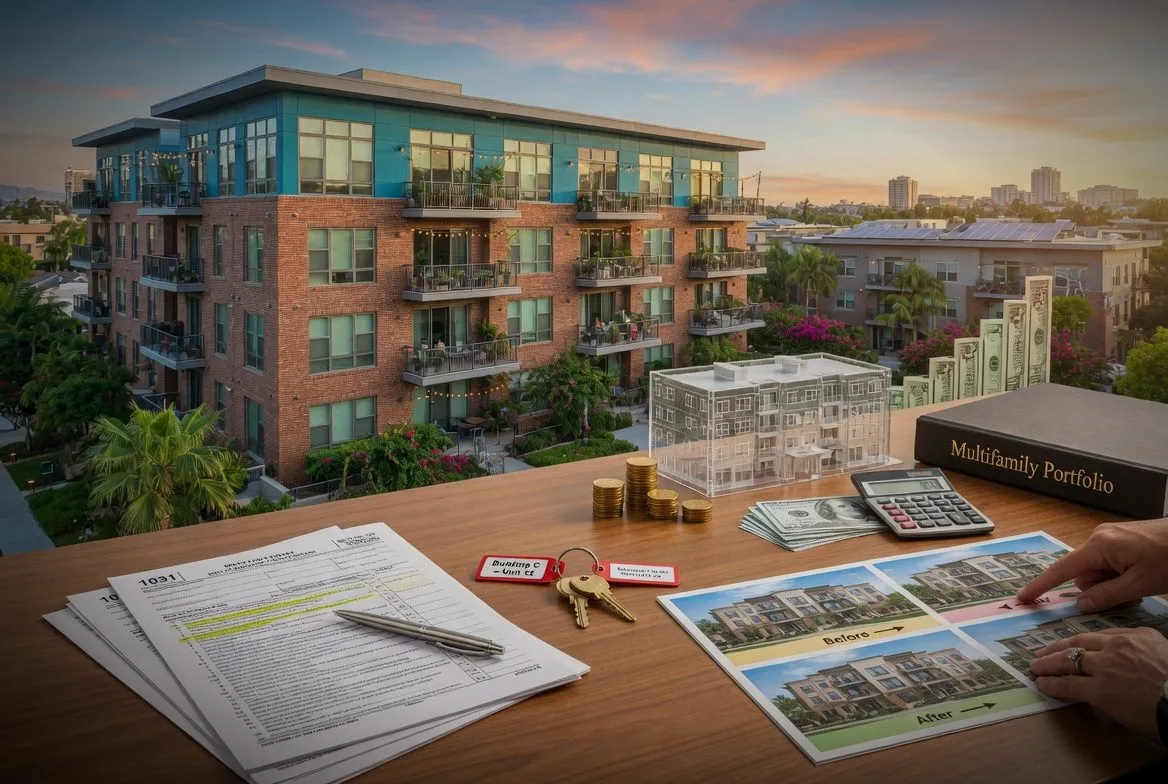
BRRRR — Buy, Rehab, Rent, Refinance, Repeat — is the most-marketed entry strategy in retail real estate investing. It's also the strategy most consistently misrepresented by the content ecosystem that promotes it.
The textbook version: buy a distressed property below market, renovate it to market condition, lease it to stabilize income, refinance to pull most or all of your initial capital back out, repeat the process indefinitely with the same dollars. In theory, you build a portfolio with infinite leverage and minimal new capital required.
In practice, BRRRR works in some markets and rate environments and breaks in others — and the difference is rarely explained until investors are already mid-cycle on a deal that won't refinance.
This is the honest version. What BRRRR actually requires, where it breaks, what 2026 conditions look like, and when it's the right strategy versus when it's a bigger commitment than the marketing suggests.
The 5 Steps, Mechanically
1. Buy. Acquire a property below market value, typically off-market, distressed, or on the market for some condition issue that turns away conventional buyers. The discount is the source of forced equity — you're buying at a price below the after-repair value (ARV) by enough to absorb renovation cost plus margin.
2. Rehab. Renovate the property to market condition. The renovation needs to bring the property to a state where it can command market rent and qualify for permanent financing.
3. Rent. Lease the property to qualifying tenants at market rent. Stabilization typically requires 3–6 months of consistent rental income before lenders will refinance based on the new rent roll.
4. Refinance. Replace the original acquisition financing (often hard money, private money, or cash) with permanent debt. The refinance is sized against the property's appraised ARV. The goal is to pull most or all of the original capital out — funding the next deal without new equity.
5. Repeat. Use the recovered capital to acquire the next property. The thesis: if you can recover 90%+ of capital each cycle, you can compound a portfolio indefinitely with minimal new equity required.
The strategy works as advertised when each step executes near projection. It breaks when any step underperforms — and the underperformance compounds across the steps.
Where the Marketing Math Comes From
BRRRR content typically presents a version of this example:
- Purchase price: $100,000
- Renovation: $30,000
- ARV: $180,000
- Refinance at 75% LTV: $135,000
- Capital recovered: $135,000 — $100K purchase — $30K rehab = $5,000 left in deal
- Monthly net cash flow after refinance: $200/door
The investor has $200/month income plus a $45,000 equity position with only $5,000 of their own capital still in the deal. The arithmetic is real. The execution risk is what the marketing leaves out.
What Actually Has to Go Right
Purchase below market by enough. The forced equity has to absorb both renovation cost and the gap between refinance LTV and total deal cost. If you pay too close to market, the math doesn't pencil regardless of execution quality.
Renovation completes on budget and on schedule. Cost overruns directly reduce capital recovery. A $30K projected rehab that lands at $42K means $12K less recovered at refinance — and often a 2–3 month timeline extension that costs additional carrying.
ARV holds at appraisal. The refinance is sized against the bank's appraisal, not your projected ARV. Appraisers are conservative. The ARV your contractor walked through with you may not be the ARV the bank books at.
Property leases at projected rent. Lenders will use either the appraisal-based market rent or the actual rent in place — whichever is lower. If you projected $1,800/month and the property is leased at $1,650, the refinance gets sized against the lower number.
Refinance terms support cash flow. This is the step that's broken in the 2026 environment for many BRRRR investors who built portfolios in 2017–2021.
Where BRRRR Breaks: 4 Failure Modes
Failure Mode 1: Rehab Cost Overrun
Industry data and contractor experience consistently show 15–40% rehab cost overruns on residential renovations, depending on property condition and rehab scope. The investor projecting a $30K rehab should be underwriting at $36K–$42K with contingency.
Most BRRRR marketing examples use the projected number, not the realistic number. The deal that works at $30K rehab cost may not work at $40K rehab cost — and the difference shows up in capital recovered at refinance.
The safer underwrite: project rehab at 120% of contractor estimate, hold 10% additional contingency reserve, expect the higher number.
Failure Mode 2: ARV Optimism
The ARV used in BRRRR underwriting is typically based on comparable sales the investor or wholesaler identified before the renovation. The bank's appraiser pulls comps independently — and frequently arrives at a lower number, especially in markets where condition variance among comps is wide.
ARV haircuts of 5–15% are common between projected ARV and actual appraised value. On a $180K projected ARV, that's $9K–$27K less in refinance proceeds — money that stays in the deal as additional equity rather than being recovered for the next acquisition.
The safer underwrite: project ARV at 90% of comparable sales, model refinance proceeds at the conservative number, treat any upside as bonus.
Failure Mode 3: Refinance Constraints in High-Rate Environments
This is the failure mode that broke many BRRRR portfolios built in 2017–2021 when rates were 3.5–4.5%.
A property purchased in 2020 with hard money at 9% interest, projected to refinance into a 4% conventional loan, has materially different economics than the same property attempting to refinance in 2026 at 7.25%.
Higher refinance rates compress in two ways:
- DSCR constraints: lenders typically require a debt service coverage ratio of 1.20–1.25 on investor properties. Higher rates mean higher debt service against the same NOI — which compresses how much loan the property can support, often pushing the actual refinance LTV below the standard 75%.
- Cash flow compression: even when the refinance closes, the higher rate eats into monthly net cash flow. The deal that produced $200/door at 4% rates may produce $50/door at 7.25% — and the investor who modeled the deal at 4% is operating a property that no longer cash flows meaningfully.
Both failure modes happened simultaneously to BRRRR portfolios maturing into refinance windows in 2023–2025. Many investors found themselves stuck with hard money loans they couldn't refinance, or refinances that left more capital in the deal than projected and produced less cash flow than underwritten.
Failure Mode 4: Rent Achievement Below Pro Forma
A property pro formaed at $1,800/month rent is dependent on actually leasing at $1,800. If the local market softens, if the renovation didn't quite reach the quality level needed for that rent, or if the comparable supply is more competitive than projected, the property may lease at $1,600–$1,700.
That $100–$200/month gap compounds:
- Annual NOI is $1,200–$2,400 lower than projected
- Refinance loan amount sizes down accordingly (DSCR-driven)
- Monthly cash flow shrinks
- Total return economics compress across the entire hold period
Rent miss is one of the most common BRRRR failure modes because it depends on market conditions outside the investor's control. The renovation can be flawless and the rent still come in below projection.
When BRRRR Actually Works
The strategy is real. It produces wealth for investors who execute it in the right conditions with the right underwriting discipline. The conditions:
Markets with consistent ARV comps and stable rent levels. Markets with deep inventory of similar properties at similar quality levels produce predictable appraisals. Markets with wide condition variance or thin transaction volume produce unpredictable ones.
Renovation scope the investor can manage. First-time BRRRR with a major rehab and a contractor the investor doesn't know is high-risk. Investors who succeed with BRRRR typically have either prior renovation experience or a long-standing GC relationship.
Conservative underwriting on every input. Rehab cost +20%, ARV -10%, rent -5%, refinance rate at current market plus 50 bps cushion. If the deal still works at those conservative inputs, the upside cases produce excellent returns. If the deal only works at the optimistic inputs, the strategy is fragile.
Low-rate refinance environments — or fixed-rate purchase debt. BRRRR economics are most reliable when refinance rates are stable and below 6%. In a higher-rate environment, the strategy still works on the right deals but produces materially lower returns.
Patience for the cycle. A BRRRR cycle typically takes 6–12 months from purchase to refinance close. Investors who need faster capital recovery should consider other strategies.
The 2026 Rate Environment: What Changes
Refinance rates for non-owner-occupied investor properties in early 2026 are running 7.0–7.75%. That's a different math environment than the 3.5–4.5% rates that defined BRRRR's golden era.
Implications for current BRRRR underwriting:
- DSCR constraints bind earlier — the property may support a 65% LTV refinance instead of 75%, leaving more capital in the deal
- Cash-on-cash returns compress — the same deal produces 5–8% CoC at current rates vs. 12–15% at 2020 rates
- Hold period mathematics change — recapturing capital for the next acquisition takes longer when each refinance leaves more equity behind
The strategy didn't die. The economics shifted. Investors entering BRRRR in 2026 should underwrite at current rates, not 2020 rates, and accept that the per-deal capital recovery will be lower than the marketing examples suggest.
If rates ease materially in 2027–2028, those same deals can be refinanced again at better terms — recovering more capital later. The strategy in the current environment is "BRRRR + future re-refi" rather than the textbook single-cycle recovery.
Honest Comparison: BRRRR vs. Alternatives
For first-time investors comparing entry strategies:
BRRRR
- Pros: forced equity creation, capital recovery for compounding, hands-on learning across full real estate lifecycle
- Cons: high execution risk, refinance market dependency, capital tied up 6–12 months per cycle, requires renovation expertise or trusted GC
Turnkey Single-Family Rental
- Pros: predictable cash flow from day one, no renovation risk, simpler underwriting
- Cons: no forced equity, full capital required per deal, lower total return potential, returns dependent on appreciation
Multifamily Syndication LP Position
- Pros: passive investment, professional management, access to larger institutional-quality assets, diversification across operator portfolio
- Cons: no operational control, illiquid for 5–7 years, dependent on operator selection and execution
Stabilized Multifamily Direct Acquisition
- Pros: asset-class quality, predictable cash flow, scalable to portfolio
- Cons: requires substantial capital per deal, slower portfolio growth than BRRRR, relies on operator cap rate environment for total return
The right strategy depends on the investor's capital, time, expertise, and risk tolerance — not on which strategy has the most YouTube videos.
The First-Deal Reality
For investors considering BRRRR as their first strategy: the math works on paper. The execution is harder than the math suggests. The first deal will probably take longer, cost more, and recover less capital than projected. That's not failure — it's normal first-deal experience.
The investors who succeed long-term with BRRRR treat the first deal as an education and the second deal as the first deal that should perform to plan. Investors who treat the first deal as the test of whether the strategy works generally conclude wrongly that it doesn't.
If you're considering BRRRR as your entry strategy, do one — with conservative underwriting, a trusted contractor, and capital you can leave in the deal if recovery is incomplete. Use that experience to calibrate your second deal. Don't scale until you've completed at least one full cycle including a successful refinance and 6 months of stable operations.
What This Means for Your Strategy Quadrant
In the 4-quadrant framework, BRRRR sits firmly in the Value-Add quadrant — meaningful renovation, repositioning, leverage that compresses during stabilization, exit-dependent returns. It's not Core, it's not Core Plus, and the marketing positioning that suggests "BRRRR is just like buying a regular rental but with extra steps" misclassifies the risk profile.
If your capital allocation thesis calls for Value-Add exposure and you have the operational capacity to execute, BRRRR is one path into that quadrant. If your thesis calls for Core or Core Plus exposure, BRRRR isn't the right vehicle regardless of how the headline returns look.
The strategy is good. The marketing is rarely honest about who it's actually good for.
[Want a deal evaluated honestly before you commit your renovation budget? See the underwriting framework that catches BRRRR overruns →]